10 Plagues Visualization Reel
These Passover weekdays inspired us to study the whole counsel of God and gain an understanding of the meaning of these precious memorials.
With the Sedar dinners, holy communion in church, and our prayer days in our homes, we draw near to the living God in reverence. He is the God who created the whole world, and He is the God of Israel.
At the time of the Exodus, Egypt was the world’s dominant geopolitical power, boasting one of the most complex and pervasive polytheistic religious systems in antiquity.
The primary reason God judged Egypt was to execute a direct assault “against all the gods of Egypt” to demonstrate His absolute supremacy.
By dismantling the Egyptian pantheon systematically, God proved to both the Egyptians and His precious people, the Israelites, that He alone was the true Creator and Lord of the universe, making the greatest empire on earth to recognize His declaration: “I AM THAT I AM”.
The plagues served as a righteous judgment upon Pharaoh and the Egyptian populace for their cruelty, oppression, and evil actions against the Hebrew people.
Pharaoh had proudly asked who the Lord was that he should obey His voice; God’s response was a multifaceted liberation that brought economic, political, and spiritual ruin to an empire built on the broken bodies of enslaved people.
God’s judgments are depicted as having a penal quality.
Because Pharaoh and his courtiers first hardened their own hearts against the initial signs, they incurred a divine, penal hardening.
Every act of resistance by the Egyptian empire resulted in a cumulative psychological and ecological devastation, providing nine distinct opportunities for repentance before the final, irreversible blow was struck.
God’s method of judgment was not a single, instantaneous annihilation, which would have left no room for repentance or the demonstration of His multifaceted power. Instead, the prolonged sequence of ten plagues removed any assumptions of coincidence, leaving no doubt that the living God was deliberately at work.
How God Judges the World Today
The principles of divine judgment demonstrated in the Egyptian plagues are not confined to antiquity; they establish an immutable paradigm for how God judges the world even today.
The plagues teach that God’s judgments are frequently directed against the false gods and idols that human societies construct to rival His authority.
In the modern era, societies do not typically worship deities with the heads of frogs, bulls, or birds; instead, the idols of the contemporary world are wealth, celebrity, authority, and entertainment.
Just as the Egyptian gods failed to provide rescue during the plagues, modern man-made gods prove fleeting, insatiable, and ultimately powerless in times of crisis.
Riches fade in the face of terminal illness, celebrity vanishes when the public gaze shifts, and authoritative power is easily crushed by the unpredictable turning of events.
God judges the world today by exposing the utter impotence of these modern idols, allowing the systems built upon them to collapse under the weight of their own inherent wickedness.
God’s method of judgment today mirrors the “penal hardening” seen in Pharaoh. When individuals obstinately persist in sin and rebellion, God’s judgment manifests in the withdrawal of His restraining grace, leaving sinners to the natural, devastating consequences of their own choices.
When sin abounds and there is no movement toward repentance, God allows the rebellious to become fully engulfed in their depravity, serving as a redemptive judgment designed to break human pride.
God utilizes natural agencies to execute His judgments. Just as the plagues utilized the natural elements of the Nile valley—turning them from sources of life into instruments of death—God allows the evil systems of the modern world to fracture.
Whether through ecological degradation, economic collapse, or social upheaval, these events are not random; they serve as a divine summons to repentance and a stark reminder that the earth and its fullness belong to the Lord.
The overarching lesson is that divine judgment is both an act of liberation for God’s precious people and a righteous retribution against those who persist in the oppression of truth and justice.
The First Plague: Water Turned to Blood
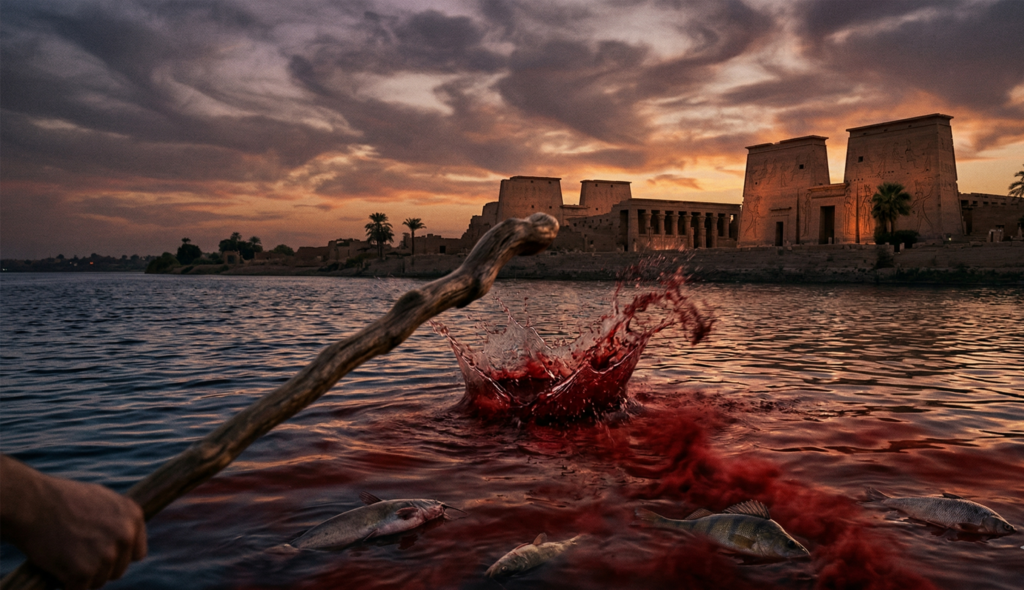
Exodus 7:17-21
“Thus says the Lord, “By this you shall know that I am the Lord: behold, with the staff that is in my hand I will strike the water that is in the Nile, and it shall turn into blood. The fish in the Nile shall die, and the Nile will stink, and the Egyptians will grow weary of drinking water from the Nile.”
’ And the Lord said to Moses, “Say to Aaron, ‘Take your staff and stretch out your hand over the waters of Egypt, over their rivers, their canals, and their ponds, and all their pools of water, so that they may become blood, and there shall be blood throughout all the land of Egypt, even in vessels of wood and in vessels of stone.’”
Moses and Aaron did as the Lord commanded. In the sight of Pharaoh and in the sight of his servants he lifted up the staff and struck the water in the Nile, and all the water in the Nile turned into blood. And the fish in the Nile died, and the Nile stank, so that the Egyptians could not drink water from the Nile. There was blood throughout all the land of Egypt.”
Whoever controls water controls life. The Nile River was the literal and spiritual lifeblood of the Egyptian economy and agriculture. This plague was a direct, calculated attack on Osiris, whose bloodstream was believed by the Egyptians to be the Nile itself. It also targeted Hapi, the god of the annual flooding, who was worshipped as the bringer of prosperity, and Khnum, the ram-headed creator god believed to be the guardian of the river’s source.
By turning the life-giving water into a loathsome cesspool of death for seven full days, God demonstrated that He alone is the giver and sustainer of life.
A Hebrew keyword in this narrative is yada (יָדַע), meaning “to know, realize, recognize, or come to understand through direct experience”. God repeatedly states that the plagues are sent so that Egypt will yada that He is the Lord. The judgment was not merely punitive; it was designed to clearly communicate a true knowledge of God upon a culture blinded by polytheism.
The Second Plague: Frogs
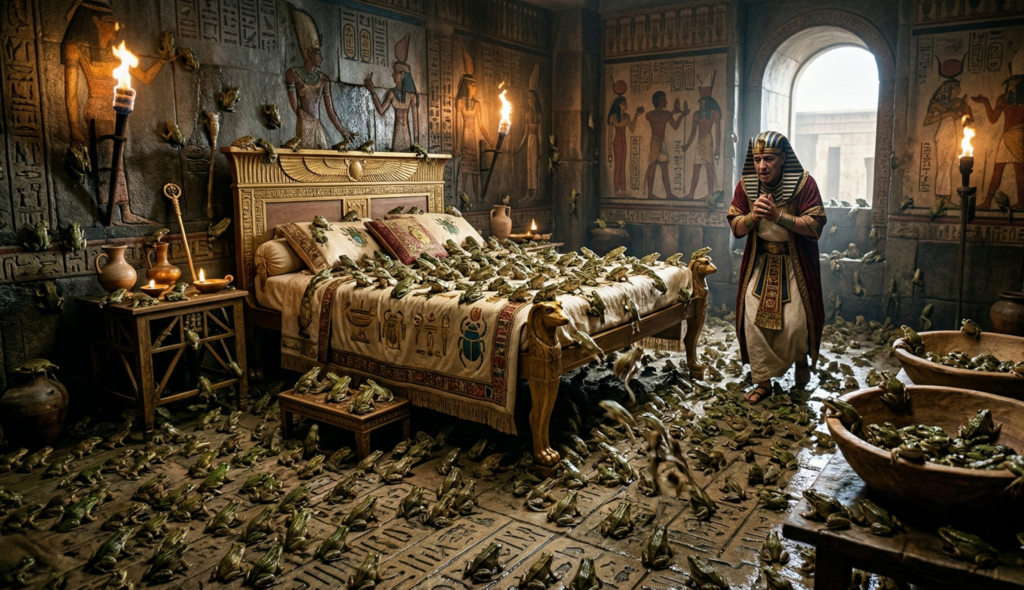
Exodus 8:1-4 and 8:15
“And the Lord spoke to Moses, “Go to Pharaoh and say to him, ‘Thus says the Lord: “Let My people go, that they may serve Me. But if you refuse to let them go, behold, I will smite all your territory with frogs.
So the river shall bring forth frogs abundantly, which shall go up and come into your house, into your bedroom, on your bed, into the houses of your servants, on your people, into your ovens, and into your kneading bowls.
And the frogs shall come up on you, on your people, and on all your servants.”’”… “But when Pharaoh saw that there was relief, he hardened his heart and did not heed them, as the Lord had said.”
This plague targeted Heqet, the frog-headed goddess of resurrection, rebirth, and fertility. The psychological torment of this plague was immense. Because the frog was a sacred animal and a symbol of procreative power, it could not be intentionally killed.
Being forced to step on, crush, and sleep alongside these nauseating reptiles brought the Egyptian religion into utter contempt, turning their object of worship into a source of unending disgust.
The lesson here revolves around the human response to divine mercy. When Pharaoh saw there was a temporary lifting of the plague, the text notes he hardened his heart.
The Hebrew concept here is a “respite” (literally, a breathing space). Instead of using this respite for true repentance, Pharaoh exploited the grace of God to resume his rebellion, demonstrating how the wicked often misuse divine patience as a license for further sin.
The Third Plague: Lice or Gnats
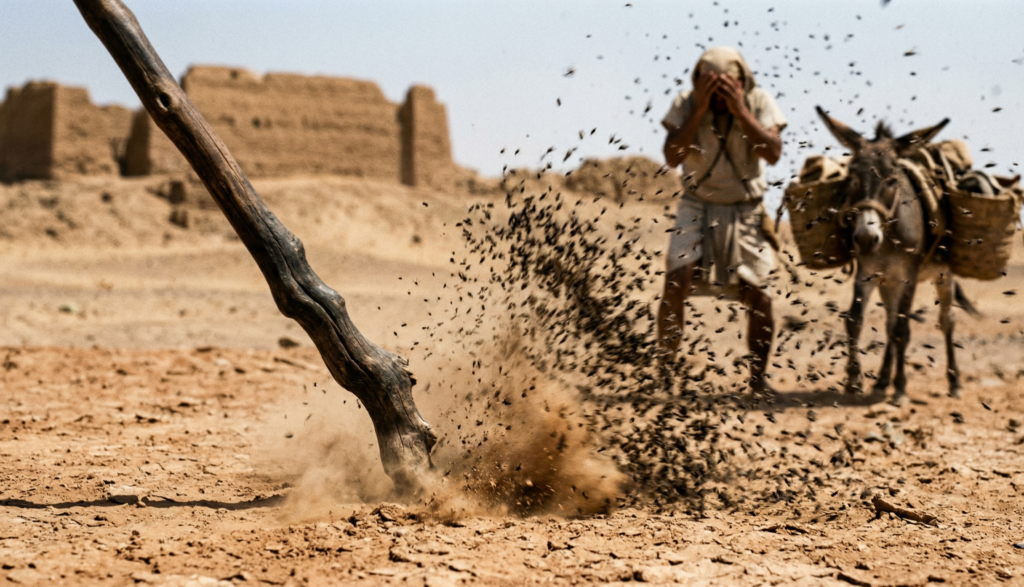
Exodus 8:16-19:
“So the Lord said to Moses, “Say to Aaron, ‘Stretch out your rod, and strike the dust of the land, so that it may become lice throughout all the land of Egypt.’” And they did so. For Aaron stretched out his hand with his rod and struck the dust of the earth, and it became lice on man and beast.
All the dust of the land became lice throughout all the land of Egypt. Now the magicians so worked with their enchantments to bring forth lice, but they could not. So there were lice on man and beast.
Then the magicians said to Pharaoh, “This is the finger of God.” But Pharaoh’s heart grew hard, and he did not heed them, just as the Lord had said.”
This plague was directed against Geb, the Egyptian god of the earth. Striking the dust of the earth—the very element from which humanity was created—served as a visceral reminder of human mortality and divine sovereignty.
The Hebrew word used here is kinnim (כִּנִּים). This word is formed by imitating the “sharp tingling sound given out by the insect when on the wing,” pointing to the likelihood that these were vicious mosquitoes endemic to the Delta.
It was during this plague that the Egyptian sorcerers, unable to manipulate such delicate creatures through their sleight-of-hand tricks, were forced to confess the limits of their magic.
They declared it “the finger of a god,” marking the first time the occult practitioners of Egypt had to admit they were facing a supernatural power completely beyond their control.
The Fourth Plague: Swarms of Flies
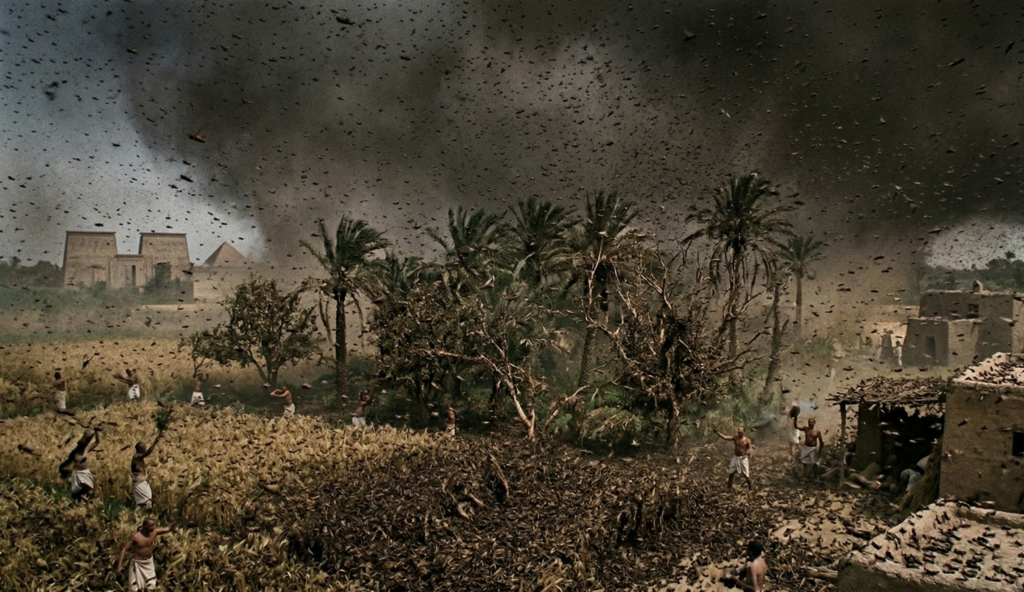
Exodus 8:20-24:
“And the Lord said to Moses, “Rise early in the morning and stand before Pharaoh as he comes out to the water. Then say to him, ‘Thus says the Lord: “Let My people go, that they may serve Me. Or else, if you will not let My people go, behold, I will send swarms of flies on you and your servants, on your people and into your houses.
The houses of the Egyptians shall be full of swarms of flies, and also the ground on which they stand. And in that day I will set apart the land of Goshen, in which My people dwell, that no swarms of flies shall be there, in order that you may know that I am the Lord in the midst of the land.
I will make a difference between My people and your people. Tomorrow this sign shall be.”’” And the Lord did so.
Thick swarms of flies came into the house of Pharaoh, into his servants’ houses, and into all the land of Egypt. The land was corrupted because of the swarms of flies.”
This plague attacked Khepri, the god of new birth represented by the scarab beetle, and Uatchit, the goddess of flies. This plague caused severe property damage, making it the first major economic strike against the empire.
The Hebrew term ‘arôb (עָרֹב) designates the species. While traditionally translated as swarms of flies, it specifically refers to the kakerlaque, a highly destructive type of beetle that inflicts painful bites and consumes property, furniture, and crops.
God demonstrated a “divine severance” by explicitly protecting the land of Goshen. This proved that He is the Lord “in the midst of the earth,” exercising absolute sovereign control over specific geographic territories, distinguishing His people from those under judgment.
The Fifth Plague: Pestilence on Livestock
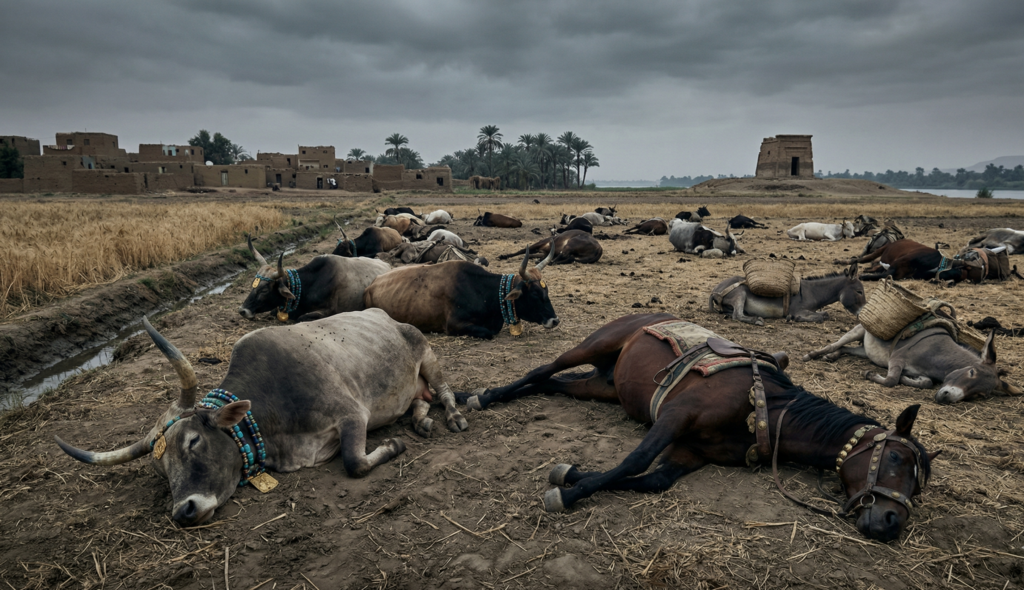
Exodus 9:1-7:
“Then the Lord said to Moses, “Go in to Pharaoh and tell him, ‘Thus says the Lord God of the Hebrews: “Let My people go, that they may serve Me. For if you refuse to let them go, and still hold them, behold, the hand of the Lord will be on your cattle in the field, on the horses, on the donkeys, on the camels, on the oxen, and on the sheep—a very severe pestilence.”
“And the Lord will make a difference between the livestock of Israel and the livestock of Egypt. So nothing shall die of all that belongs to the children of Israel.”
Then the Lord appointed a set time, saying, “Tomorrow the Lord will do this thing in the land.” So the Lord did this thing on the next day, and all the livestock of Egypt died; but of the livestock of the children of Israel, not one died.
Then Pharaoh sent, and indeed, not even one of the livestock of the Israelites was dead. But the heart of Pharaoh became hard, and he did not let the people go.”
This severe pestilence was a direct assault on Apis, the sacred bull god associated with food and provision, and Hathor, the cow goddess who occupied a central place in the Egyptian pantheon. It constituted a massive economic disaster that destroyed Egypt’s transportation, military supplies, and farming infrastructure.
If the Egyptian livestock were gods, they were now proven completely powerless to resist the God of the Hebrews. The teaching here is profound: the wealth and security of the wicked are fragile and can be easily destroyed by God when they are used to oppose His will.
The Sixth Plague: Boils
Exodus 9:8-12:
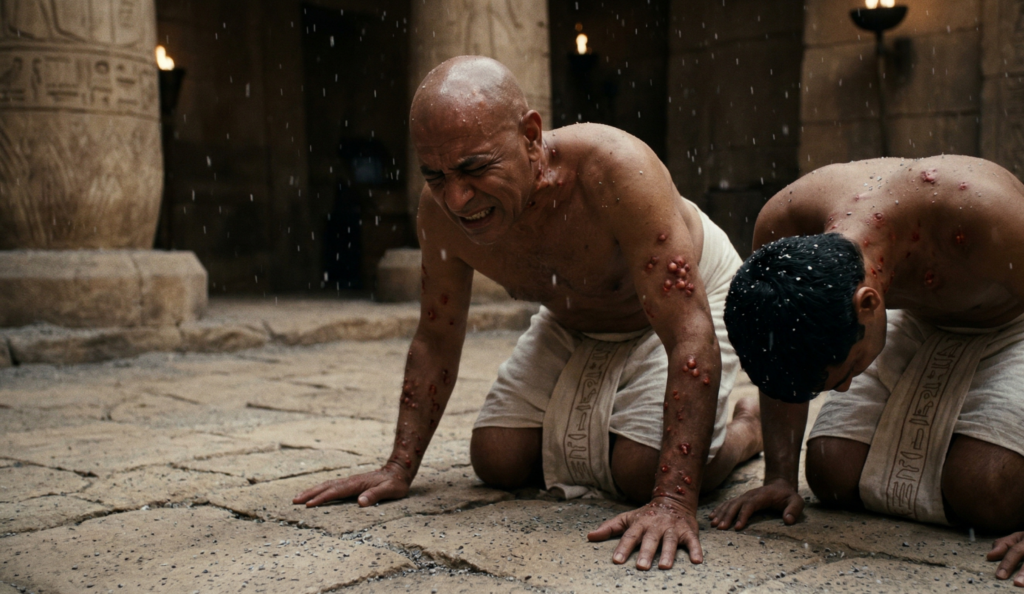
“So the Lord said to Moses and Aaron, “Take for yourselves handfuls of ashes from a furnace, and let Moses scatter it toward the heavens in the sight of Pharaoh. And it will become fine dust in all the land of Egypt, and it will cause boils that break out in sores on man and beast throughout all the land of Egypt.”
Then they took ashes from the furnace and stood before Pharaoh, and Moses scattered them toward heaven. And they caused boils that break out in sores on man and beast. And the magicians could not stand before Moses because of the boils, for the boils were on the magicians and on all the Egyptians.
But the Lord hardened the heart of Pharaoh; and he did not heed them, just as the Lord had spoken to Moses.”
Targeting Imhotep (the god of medicine) and Thoth (the god of magic and healing), this plague brought the battle directly to the human body. The physical debilitation proved that Pharaoh could not even protect the health and well-being of his people, stripping away the illusion of his divine supreme kingship.
The magicians, covered in festering sores, were physically unable to stand before Moses, representing the complete collapse and public humiliation of Egypt’s spiritual and intellectual leadership. It is at this point that the text transitions to state explicitly that “the Lord hardened the heart of Pharaoh,” indicating that the line of penal abandonment had been crossed.
The Seventh Plague: Hail and Fire
Exodus 9:22-26:
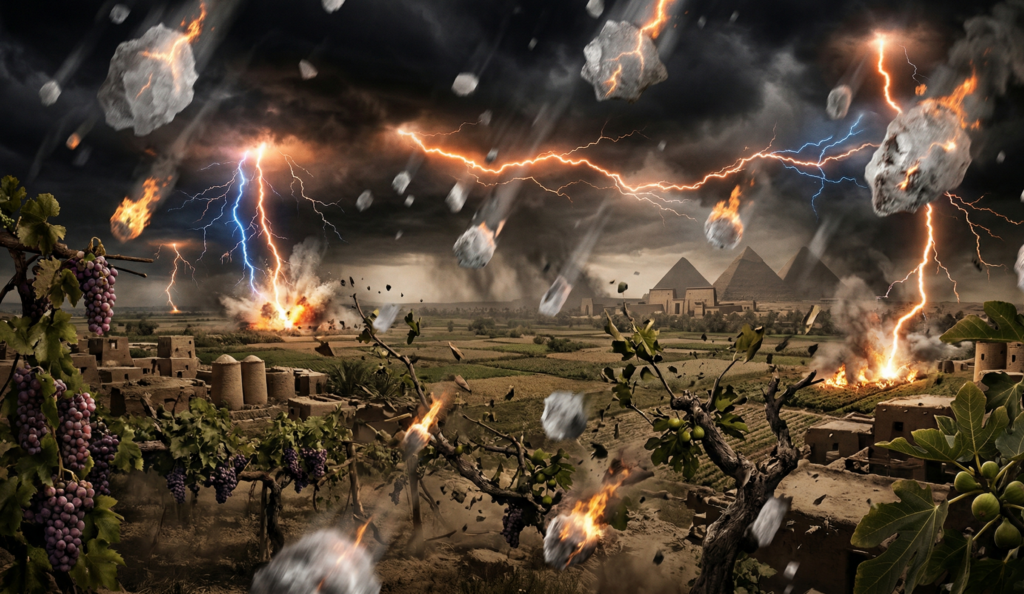
“Then the Lord said to Moses, “Stretch out your hand toward heaven, that there may be hail in all the land of Egypt—on man, on beast, and on every herb of the field, throughout the land of Egypt.” And Moses stretched out his rod toward heaven; and the Lord sent thunder and hail, and fire darted to the ground.
And the Lord rained hail on the land of Egypt. So there was hail, and fire mingled with the hail, so very heavy that there was none like it in all the land of Egypt since it became a nation. And the hail struck throughout the whole land of Egypt, all that was in the field, both man and beast; and the hail struck every herb of the field and broke every tree of the field.
Only in the land of Goshen, where the children of Israel were, there was no hail.”
Nut (the sky goddess) and Osiris (the god of crops and fertility) were the targets of this devastation. This unprecedented meteorological disaster broke the small boughs and twigs, ruining the flax and barley crops, striking at the heart of an empire that prided itself on being the breadbasket of the ancient world.
Before this plague, God explicitly warned Pharaoh so that those who feared the Lord’s word could bring their servants and livestock indoors. This demonstrates that God’s judgments are always tempered with mercy and a call to obedience; those who heeded the warning were spared, while those who ignored it were destroyed. It introduces the concept that salvation amidst judgment is available to those who align themselves with the word of God.
The Eighth Plague: Locusts
Exodus 10:4-5 and 10:12-15
“Or else, if you refuse to let My people go, behold, tomorrow I will bring locusts into your territory. And they shall cover the face of the earth, so that no one will be able to see the earth; and they shall eat the residue of what is left, which remains to you from the hail, and they shall eat every tree which grows up for you out of the field.”
“Then the Lord said to Moses, “Stretch out your hand over the land of Egypt for the locusts, that they may come upon the land of Egypt, and eat every herb of the land—all that the hail has left.”
So Moses stretched out his rod over the land of Egypt, and the Lord brought an east wind on the land all that day and all that night. When it was morning, the east wind brought the locusts.
And the locusts went up over all the land of Egypt and rested on all the territory of Egypt. They were very severe; previously there had been no such locusts as they, nor shall there be such after them.
For they covered the face of the whole earth, so that the land was darkened; and they ate every herb of the land and all the fruit of the trees which the hail had left.
So there remained nothing green on the trees or on the plants of the field throughout all the land of Egypt.”
Targeting deities of the harvest and atmosphere (Serapia and Min), the locusts eradicated the wheat and doora crops that had survived the hail.
Absolute desolation of an insect invasion that darkened the sky and consumed the region’s final food supply, induced famine, and proved that the true God wields supreme authority over nature.
The Hebrew word ala (עָלָה), meaning “to come upon” or ascend, is utilized here. It gives the terrifying visual idea of a great black cloud rising and being carried by the wind to consume the land, evoking the image of a supernatural, hostile army acting under divine command to strip an empire of its remaining pride.
The Ninth Plague: Thick Darkness
Exodus 10:21-23:
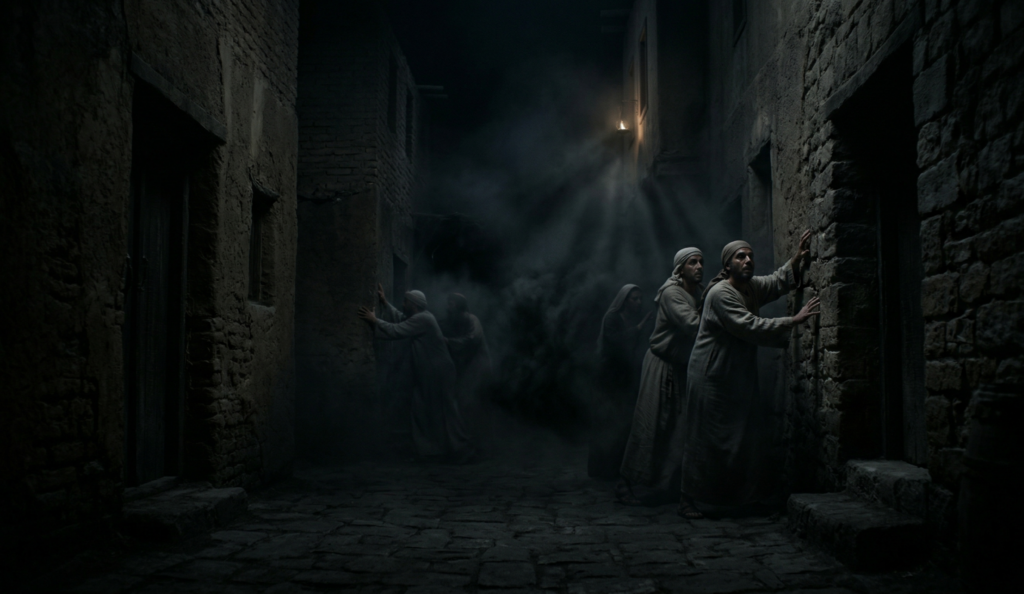
“Then the Lord said to Moses, “Stretch out your hand toward heaven, that there may be darkness over the land of Egypt, darkness which may even be felt.” So Moses stretched out his hand toward heaven, and there was thick darkness in all the land of Egypt three days.
They did not see one another; nor did anyone rise from his place for three days. But all the children of Israel had light in their dwellings.”
This was a direct, humiliating strike against Ra, the supreme sun god of Egypt. To the Egyptians, it appeared as though Ra was dead and that set Apophis (the Great Serpent) to encircle the world in tangible darkness.
The profound nature of this darkness is captured in the Hebrew terms koshekh aphelah (an absolute obscurity of darkness) and v’yamesh khoshekh (a darkness that one can feel or grasp).
This preternatural event used the Khamsin, the burning desert wind that brings dense, impalpable sand, physically blinding, suffocating, and terrifying the populace into total immobility.
The teaching points to the ultimate reality of spiritual blindness: those who reject the light of God are eventually given over to an isolating, debilitating darkness.
The Tenth Plague: Death of Egyptian Firstborns & Beasts
Exodus 11:1-10, 12:12, and 12:29-30
“And the Lord said to Moses, “I will bring one more plague on Pharaoh and on Egypt. Afterward he will let you go from here. When he lets you go, he will surely drive you out of here altogether.
Speak now in the hearing of the people, and let every man ask from his neighbor and every woman from her neighbor, articles of silver and articles of gold.”
And the Lord gave the people favor in the sight of the Egyptians. Moreover the man Moses was very great in the land of Egypt, in the sight of Pharaoh’s servants and in the sight of the people.
Then Moses said, “Thus says the Lord: ‘About midnight I will go out into the midst of Egypt; and all the firstborn in the land of Egypt shall die, from the firstborn of Pharaoh who sits on his throne, even to the firstborn of the female servant who is behind the handmill, and all the firstborn of the animals.
Then there shall be a great cry throughout all the land of Egypt, such as was not like it before, nor shall be like it again. But against none of the children of Israel shall a dog move its tongue, against man or beast, that you may know that the Lord does make a difference between the Egyptians and Israel.’
And all these your servants shall come down to me and bow down to me, saying, ‘Get out, and all the people who follow you!’ After that I will go out.”
Then he went out from Pharaoh in great anger. But the Lord said to Moses, “Pharaoh will not heed you, so that My wonders may be multiplied in the land of Egypt.”
So Moses and Aaron did all these wonders before Pharaoh; and the Lord hardened Pharaoh’s heart, and he did not let the children of Israel go out of his land.” (Exodus 11:1-10)
“For I will pass through the land of Egypt on that night, and will strike all the firstborn in the land of Egypt, both man and beast; and against all the gods of Egypt I will execute judgment: I am the Lord.” (Exodus 12:12)
“And it came to pass at midnight that the Lord struck all the firstborn in the land of Egypt, from the firstborn of Pharaoh who sat on his throne to the firstborn of the captive who was in the dungeon, and all the firstborn of livestock.
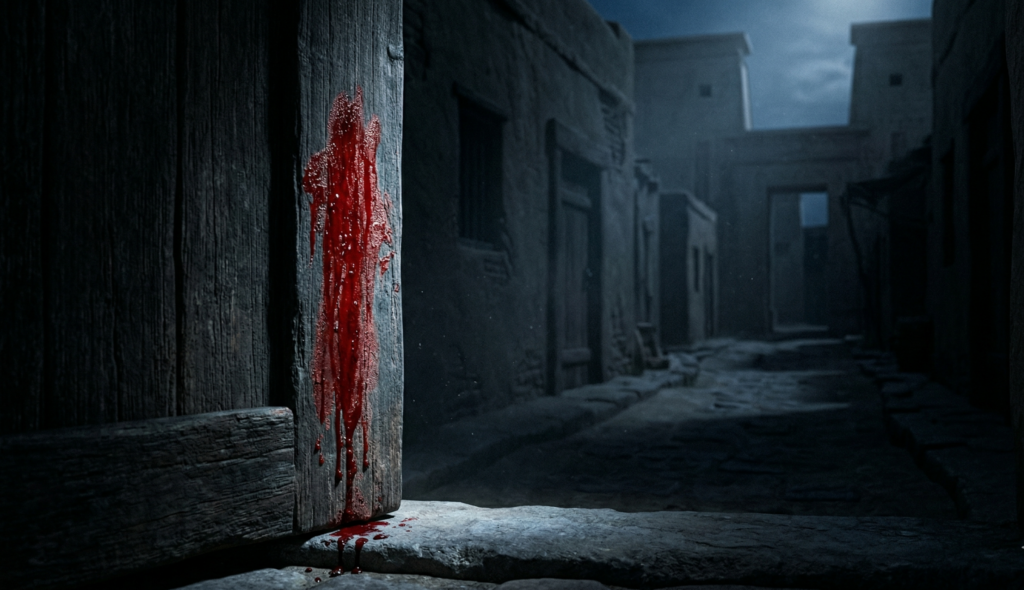
So Pharaoh rose in the night, he, all his servants, and all the Egyptians; and there was a great cry in Egypt, for there was not a house where there was not one dead.” (Exodus 12:29-30)
The final plague was an unmitigated judgment on Pharaoh himself, who was worshipped as the divine descendant of the gods.
This blow differed from the prior nine; it was not mediated by natural phenomena but was the direct, terrifying intervention of the divine “destroyer”. The execution of the firstborn demonstrated that God claims ultimate ownership over all human life and the future of every dynasty.
The Hebrew keyword here is pesahh (פֶּסַח), meaning Passover. The blood struck on the doorposts was an atonement, a visual “token” of faith and obedience to God that shielded the Israelites from the destroyer.
God also utilizes the concepts of gāreš (גָּרֵשׁ, to drive out) and šellach (שַׁלְּחֶ, to send away), demonstrating that liberation is achieved not by human negotiation, but by a divine expulsion that supernaturally removes God’s people from the domain of darkness.
Another keyword here is the precision of God’s action: be’Et ratzOn (בעת רצון, the acceptable time) and baiyom HaHu (ביום ההוא, in that day), showing that divine judgment arrives precisely according to God’s sovereign timetable.
Harmony Of Plagues In New Testament:
The Book of Revelation
The harmony of the Egyptian plagues finds its ultimate, eschatological fulfillment in the New Testament, specifically within the Book of Revelation.
The plagues of Exodus serve as the historical “type” for the apocalyptic future of the final outpouring of divine wrath upon the anti-God world system.
“Babylon” and the “Beast” represent the ultimate culmination of the world-power, a spiritual Egypt that oppresses God’s people and demands idolatrous worship.
The Greek term phiale (φιάλη, vials or shallow bowls) and plege (πληγή, plagues or blows) are used to describe these final judgments.
The song sung by the victorious saints in Revelation 15 is explicitly called the “song of Moses,” drawing a direct, undeniable parallel between Israel’s triumph over Pharaoh at the Red Sea and the bride of Christ’s ultimate triumph over the Beast. The judgments are declared hosios (ὅσιος, holy or righteous), reflecting the sacred obligation of God to vindicate His righteousness and punish unrepentant evil.
The pouring out of the seven vials in Revelation 16 mirrors the plagues of Egypt with striking precision. Revelation 16:1-21
“And I heard a great voice out of the temple saying to the seven angels, Go your ways, and pour out the vials of the wrath of God upon the earth.
And the first went, and poured out his vial upon the earth; and there fell a noisome and grievous sore upon the men which had the mark of the beast, and upon them which worshipped his image.
And the second angel poured out his vial upon the sea; and it became as the blood of a dead man: and every living soul died in the sea.
And the third angel poured out his vial upon the rivers and fountains of waters; and they became blood. And I heard the angel of the waters say, Thou art righteous, O Lord, which art, and wast, and shalt be, because thou hast judged thus. For they have shed the blood of saints and prophets, and thou hast given them blood to drink; for they are worthy.
And I heard another out of the altar say, Even so, Lord God Almighty, true and righteous are thy judgments. And the fourth angel poured out his vial upon the sun; and power was given unto him to scorch men with fire. And men were scorched with great heat, and blasphemed the name of God, which hath power over these plagues: and they repented not to give him glory.
And the fifth angel poured out his vial upon the seat of the beast; and his kingdom was full of darkness; and they gnawed their tongues for pain, And blasphemed the God of heaven because of their pains and their sores, and repented not of their deeds.
And the sixth angel poured out his vial upon the great river Euphrates; and the water thereof was dried up, that the way of the kings of the east might be prepared. And I saw three unclean spirits like frogs come out of the mouth of the dragon, and out of the mouth of the beast, and out of the mouth of the false prophet.
For they are the spirits of devils, working miracles, which go forth unto the kings of the earth and of the whole world, to gather them to the battle of that great day of God Almighty.
Blessed is he that watcheth, and keepeth his garments, lest he walk naked, and they see his shame. And he gathered them together into a place called in the Hebrew tongue Armageddon.
And the seventh angel poured out his vial into the air; and there came a great voice out of the temple of heaven, from the throne, saying, It is done. And there were voices, and thunders, and lightnings; and there was a great earthquake, such as was not since men were upon the earth, so mighty an earthquake, and so great.
And the great city was divided into three parts, and the cities of the nations fell: and great Babylon came in remembrance before God, to give unto her the cup of the wine of the fierceness of his wrath.
And every island fled away, and the mountains were not found. And there fell upon men a great hail out of heaven, every stone about the weight of a talent: and men blasphemed God because of the plague of the hail; for the plague thereof was exceeding great.”
The First Vial (Revelation 16:2)
Links this directly to the sixth Egyptian plague of boils (Exodus 9). The “evil sore” denotes a throbbing, hateful affliction—perhaps spiritual or mental as much as physical—that destroys the self-complacency of those bearing the mark of the beast.
The Second and Third Vials (Revelation 16:3-4)
This corresponds seamlessly with the first Egyptian plague of blood (Exodus 7). The sea represents the tumultuous passions and impulses of the masses. When directed by earthliness rather than God, these forces become completely corrupt, killing every token of higher moral life.
Because the wicked historically shed the blood of saints, God executes perfect justice by turning their water into blood, eliciting praise from the altar for His righteous judgments.
The Fifth Vial (Revelation 16:10-11)
This is the exact link to the ninth Egyptian plague of darkness (Exodus 10). When humanity shuts out the spiritual light of God, the “smoke of their own candles” ultimately obscures the heavens. Moral evil, when linked with intellectual pride and a refusal to repent, inevitably leads to a kingdom of agonizing, suffocating darkness where people gnaw their tongues in pain yet still blaspheme the Creator.
The Sixth Vial (Revelation 16:13)
Drawing upon the second Egyptian plague of frogs (Exodus 8), these frog-like entities are demonic spirits. They emerge from hate (the dragon), world-authority (the beast), and occult false prophet to deceive the nations through false, fake miracles, gathering them for a battle that they were defeated by Christ at Armageddon.
Just as the frogs in Egypt permeated every domain, these unclean spirits permeate the political systems of the earth by ceaseless croaking, which is the propaganda and lies we see in our world even right now.
The Seventh Vial (Revelation 16:21)
Mirroring the seventh Egyptian plague of hail (Exodus 9), this final destructive weather event shatters the confederacy of the wicked.
Notably, in both Exodus and Revelation, the extreme suffering brought by the plagues does not inherently produce repentance in the wicked. Instead, it exposes the absolute depth of their rebellion, as they curse God on account of the plague rather than turn to Him in humility. Sin thus becomes its own worst penalty, solidifying the hardened heart into eternal rebellion.
How God Judges Wickedness
God judges wrong by striking at the very heart of human idolatry. In Egypt, He systematically dismantled the false deities of the Nile, the earth, the sky, and the throne, proving that the gods of human invention are powerless.
Today, He executes judgment upon the systems of the world—wealth, authoritative dominance, and secular humanism—by exposing their ultimate inability to save or sustain life.
The profound harmony between the Old Testament plagues of Exodus, their poetic remembrance in the Psalms, and their eschatological fulfillment in the New Testament vials of Revelation demonstrates that God’s character is unchanging.
He is patient, offering multiple respites and warnings, but there comes a definitive point at which the persistent hardening of the human heart results in judicial abandonment. When people refuse the light, they are given over to darkness that can be felt
Ultimately, the plagues teach that true liberation—whether from the physical bondage of Egypt or the spiritual bondage of the apocalyptic Beast—is found only in the atoning blood of the Lamb.
It is this blood, applied in obedience, which allows the righteous wrath of a holy God to pass over His people, securing their deliverance while perfectly judging the wrong of a rebellious world
Titus 2:12 -14 For the grace of God has appeared that offers salvation to all people. It teaches us to say “No” to ungodliness and worldly passions, and to live self-controlled, upright and godly lives in this present age, while we wait for the blessed hope—the appearing of the glory of our great God and Savior, Jesus Christ, who gave himself for us to redeem us from all wickedness and to purify for himself a people that are his very own, eager to do what is good.
Jude 1:4 For certain individuals whose condemnation was written about long ago have secretly slipped in among you. They are ungodly people, who pervert the grace of our God into a license for immorality and deny Jesus Christ our only Sovereign and Lord.
The living GOD is still moving in this world, He is a God of Justice!
AMEN
The 10 plagues of ancient Egypt were not merely random acts of destruction, nor were they an arbitrary display of divine wrath. They constituted a structured, progressive, execution of judgment.