Video: Purim 5786 Footage From Esther’s Missions/Events Collective
Although the Book of Esther does not mention God by name, the narrative is saturated with divine providence.
Through a series of seemingly coincidental events, the preservation of the living God’s covenant people is secured.
Purim In The Bible
The Feast of Purim is a joyful celebration commemorating the salvation of the Jewish people from a state-sanctioned genocide orchestrated by the Persian government.
The historical foundation of Purim is explicitly codified in biblical text.
Esther 9:24-26 “Haman the son of Hammedatha, the Agagite, the enemy of all the Jews, had devised against the Jews to destroy them, and had cast Pur, that is, the lot, to consume them, and to destroy them; But when Esther came before the king, he commanded by letters that his wicked device, which he devised against the Jews, should return upon his own head, and that he and his sons should be hanged on the Gibbet. Wherefore they called these days Purim after the name of Pur. Therefore for all the words of this letter, and of that which they had seen concerning this matter, and which had come unto them,”
The word “Purim” is the plural of the Persian or Akkadian word Pur, which means “lot” directly. The name is derived from the method Haman used to determine the most auspicious day to execute his plot against the Jews. Haman was a practicing wizard who relied on witchcraft to do evil, because he relied on ancient Near Eastern practices of cleromancy (divination by casting lots), Haman cast Pur to find a “divination aligned day” for his genocide.
The lot eventually fell on the thirteenth day of the twelfth month, the month of Adar.
The ‘lot’ or the day the divination selected was actually providential timing, because the lot fell nearly a full year in the future and provided an essential chronological buffer. This delay allowed ample time for the geopolitical and courtly dynamics to shift, enabling Mordecai and Esther to intercede and legally reverse the decree.
The festival is observed annually on the 14th and 15th of Adar, serving as a perpetual reminder of divine deliverance.
Miracles of Purim? It Was All Divine Providence…
Unlike the Exodus narrative, which features overt supernatural disruptions of natural laws, the Book of Esther contains miracles of providence. While the name of God is absent, the “finger of God” is visible in every chapter, shaping human decisions, political laws, and seemingly random events to achieve a redemptive outcome.
I, too, raise my hands towards heaven, praising God for how He is in every detail. He orchestrates everything in our lives. That’s why I walk in obedience: I trust Him with all my heart and do not lean on my own understanding.
I pray that, as you read these miracles, which we systematically categorized as a sequence of sovereignly timed events that operate entirely within the bounds of human agency, you will be encouraged to know that God is accomplishing His divine will in your life.
Even when you do not understand, as human beings, we are limited because we do not know the future. Trusting God with our future and allowing His Spirit to lead us creates moments of divine providence that we could never find or strive to obtain on our own wisdom or strength.
Supernatural Intervention In The Book of Esther
| The Deposition of Vashti | King Ahasuerus, merry with wine, orders Queen Vashti to display her beauty. She refuses and is deposed. | A despot’s drunken anger creates a sovereignly ordained vacuum on the throne, setting the stage for a Jewish girl to be elevated to the highest seat of influence in the empire. |
| The Selection of Esther | Out of the multitude of virgins gathered from 127 provinces, Esther specifically finds favor in the eyes of Hegai and the King. | God grants Esther an unmerited favor and grace that supersedes mere physical beauty, positioning her perfectly within the royal court. |
| The Discovery of the Plot | Mordecai serendipitously overhears the plot of Bigthan and Teresh to assassinate the king, reports it, but goes unrewarded. | The delayed reward is a crucial mechanism of providence; it ensures the king’s debt to Mordecai remains unpaid until the EXACT moment it is needed to thwart Haman’s plot. |
| The Casting of the Lot (Pur) | Haman’s reliance on sorcery and divination results in the date of annihilation being set eleven months away. | The counsel of mediums and divination superstition is sovereignly overruled to provide the necessary chronological buffer for salvation, demonstrating God’s sovereignty over pagan gods and demonic practices. |
| The King’s Insomnia | On the EXACT night before Haman plans to ask for Mordecai’s execution, the king cannot sleep and orders the chronicles to be read. | This is the most striking evidence of GOD’S PRESENCE; the reader of the book “happens” to open to the EXACT page detailing Mordecai’s unrewarded intelligence that uncovered an assassination plot at the precise moment it mattered most. |
| Haman’s ill-Timed Arrival | Haman enters the outer court at the PRECISE moment the king is pondering how to honor Mordecai. | Haman’s arrogance leads him to prescribe royal HONORS for himself, which the king then forces him to bestow upon his worst enemy, initiating his downfall. |
| Haman at the coach | The king steps into the garden in a rage and returns at the EXACT moment Haman falls upon Esther’s couch to beg for his life. | The king misinterprets this as an assault, which seals Haman’s doom, turning Haman’s desperate plea into the catalyst for his immediate execution. |
Through these interconnected events, the narrative demonstrates that divine will is accomplished flawlessly without suspending natural laws.
The glorious miracles of Purim are the grand, invisible tapestry of geopolitical and interpersonal orchestration that proves heaven rules!
Generational Context
The conflict in the Book of Esther is the culmination of an ancient, intergenerational war.
Mordecai and Esther: The Tribe of Benjamin and the Lineage of Kish
The text introduces Mordecai with a specific, deliberate, and highly significant genealogical record.
Esther 2:5-7 “Now in Shushan the palace there was a certain Jew, whose name was Mordecai, the son of Jair, the son of Shimei, the son of Kish, a Benjamite; Who had been carried away from Jerusalem with the captivity which had been carried away with Jeconiah king of Judah, whom Nebuchadnezzar the king of Babylon had carried away. And he brought up Hadassah, that is, Esther, his uncle’s daughter: for she had neither father nor mother, and the maid was fair and beautiful; whom Mordecai, when her father and mother were dead, took for his own daughter.”
Mordecai is explicitly identified as a Jew from the tribe of Benjamin. His lineage is traced through his father, Jair; his grandfather, Shimei; and his great-grandfather, Kish. Mordecai is a descendant of the royal Benjamite lineage.
The text states that Mordecai’s ancestors were taken into exile by Nebuchadnezzar in 597 B.C., along with Jeconiah, placing Mordecai’s family in the eastern empire for several generations.
Esther was the daughter of Mordecai’s uncle, Abihail, making her Mordecai’s younger cousin, whom he adopted as his own daughter upon the death of her parents. She bore two names, reflecting her dual identity as a diaspora Jew living in a pagan society.
Her Hebrew name, Hadassah, translates to “myrtle,” a fragrant, beautiful tree that symbolizes peace and thanksgiving.
Her Persian name, Esther, is derived from a Persian root meaning “star”. This dual nomenclature highlights the tension of maintaining a covenantal identity within a dominant, assimilating culture, such as we experience in corporate and business settings.
Haman the Agagite and the Resurgence of Amalek
The primary antagonist of the narrative is introduced with equal genealogical precision to establish the historical weight and severity of his hatred.
Esther 3:1-2 “After these things did king Ahasuerus promote Haman the son of Hammedatha the Agagite, and advanced him, and set his seat above all the princes that were with him. And all the king’s servants, that were in the king’s gate, bowed, and reverenced Haman: for the king had so commanded concerning him. But Mordecai bowed not, nor did him reverence.”
Haman is identified as the “son of Hammedatha the Agagite”. The term “Agagite” implies direct descent from Agag, the king of the Amalekites. The Amalekites were an ancient, nomadic people who became the very first nation to attack the Israelites in the wilderness after the Exodus from Egypt in Exodus 17
Because they attacked the weak and weary at the rear of the Israelite column, God declared perpetual war against them, vowing to blot out the memory of Amalek from under heaven.
Deuteronomy 25:17-19 “Remember what Amalek did to you on the way as you were coming out of Egypt, 18how he met you on the way and attacked your rear ranks, all the stragglers at your rear, when you were tired and weary; and he did not fear God. 19Therefore it shall be, when the Lord your God has given you rest from your enemies all around, in the land which the Lord your God is giving you to possess as an inheritance, that you will blot out the remembrance of Amalek from under heaven. You shall not forget.
Centuries later, God commanded the Benjamite King Saul (the son of Kish) to execute divine judgment by utterly destroying the Amalekites and their King Agag (1 Samuel 15). Saul directly disobeyed this command, sparing Agag and the best of the livestock, a catastrophic failure of leadership that resulted in God tearing the kingdom of Israel away from Saul’s lineage. The prophet Samuel subsequently executed Agag, but the Amalekite bloodline survived.
The author of the book of Esther deliberately frames this conflict as the final, decisive battle of an ancient ancestral feud. Mordecai, the Benjamite descendant of Kish, is pitted directly against Haman, the descendant of Agag. Through the events of this book, Mordecai successfully completes the mandate that his ancestor King Saul failed to execute.
Glory to GOD, the Word of the Lord must be fulfilled from generation to generation!
Haman Could Not Be Content
Haman’s virulent hatred toward the Jewish people was ignited by a highly specific, personal slight: Mordecai’s steadfast refusal to bow down or prostrate himself as Haman passed through the king’s gate.
Mordecai’s objection was grounded in deep religious and ethnic convictions. For a devout Jew, such an extreme act of obeisance equated to giving divine honors to a mortal man, an act bordering on idolatry. Furthermore, Mordecai was of royal lineage; as a Benjamite, he would never allow himself to submit to a descendant of the Amalekites, Israel’s sworn ancestral enemies.
When Haman learned that Mordecai was a Jew, his wounded ego and irrational pride metastasized into a genocidal fury. He scorned the idea of killing only Mordecai; instead, he sought to eradicate the entire Jewish race throughout the 127 provinces of the Persian Empire. He approached the king with a classic, venomous strategy of anti-semitic persecution.
Esther 3:8 “And Haman said unto king Ahasuerus, There is a certain people scattered abroad and dispersed among the people in all the provinces of thy kingdom; and their laws are diverse from all people; neither keep they the king’s laws: therefore it is not for the king’s profit to suffer them.”
Haman argued that the Jews’ distinct customs, dietary laws, and sabbaths made them an inherent threat to the stability of the state. To secure the king’s approval and offset any potential loss of tax revenue, Haman offered an astronomical bribe: 10,000 talents of silver to be deposited directly into the royal treasury. This sum, estimated to be roughly two-thirds of the empire’s annual revenue, was likely intended to be recouped by plundering the assets of the Jews if the antisemitic genocide had occurred. The king agreed, handed his signet ring to Haman, and the decree of annihilation was published.
Haman’s actions were heavily influenced by his primary counselor and confidante: his wife, Zeresh. The name Zeresh is derived from an old Persian word for “gold.”
She was the daughter of Tatnai, a high-ranking Persian governor. When Haman returned home from Esther’s first banquet, he boasted of his vast wealth and his exclusive invitation to dine with the queen, but complained that none of it satisfied him as long as Mordecai refused to bow.
Instead of acting as a voice of reason, Zeresh and his friends served as a moral enabler, amplifying his hatred.
Esther 5:14 “Then said Zeresh his wife and all his friends unto him, Let a gibbet be made of fifty cubits high, and tomorrow speak thou unto the king that Mordecai may be hanged thereon: then go thou in merrily with the king unto the banquet. And the thing pleased Haman; and he caused the gibbet to be made.”
My bible commentaries explain how the execution method intended by these gibbets was not hanging with a rope—a practice largely unknown to the ancient Persians—but rather a violent impalement upon a massive wooden stake. The extraordinary height of fifty cubits (approximately 75 feet) was specifically recommended by Zeresh to make Mordecai’s agonizing death a massive public spectacle, satisfying Haman’s extreme arrogance and serving as a terrifying deterrent to the entire city of Susa. Zeresh’s counsel perfectly encapsulates the destructive and distorting power of unbridled hatred.
Esther’s Divine Favor
Esther was taken into the “house of the women,” a secluded sector of the royal citadel, placed under the strict custody of Hegai, the king’s eunuch. The candidates were systematically assembled by royal commissioners from 127 provinces, reflecting the vast, intimidating reach of the Persian Empire and the intensely competitive, high-stakes nature of this royal selection process.
However, operating covertly within this oppressive, dehumanizing system was the unmistakable mechanism of divine favor. Esther, whose natural, unadorned beauty is noted early in the text, immediately “obtained kindness” and “favour in his sight” from Hegai. Hegai’s preferential treatment manifested rapidly; he acted “speedily” to provide her with her requisite purification items, allocated her a special daily dietary allowance, assigned her seven choice, hand-picked maidens from the king’s house, and advanced her to the most optimal, luxurious quarters within the harem.
This rapid, unexplainable acquisition of favor echoes the unmerited grace bestowed upon individuals elected for divine purposes. God was strategically positioning Esther, utilizing the very mechanisms of a pagan empire to elevate His chosen instrument long before the true test of her character—the genocide decree of Haman—ever materialized.
The Crucible of the Harem: Esther’s Physical and Cultural Preparation
Before Esther could intervene in this geopolitical crisis, she had to navigate the perilous, highly regimented, and pagan environment of the Persian royal harem. Following Vashti’s deposition, the king’s servants proposed a massive search for beautiful young virgins from across the empire to serve as candidates for the new queen.
The preparation required to meet the king was an exhaustive, legally mandated ritual of beautification.
Esther 2:12 “Now when every maid’s turn was come to go in to king Ahasuerus, after that she had been twelve months, according to the manner of the women, (for so were the days of their purifications accomplished, to wit, six months with oil of myrrh, and six months with sweet odours, and with other things for the purifying of the women;)”
The word “manner” translates as the unyielding “law or ordinance” of the women, underscoring the rigid protocols of the Persian harem. Each virgin underwent a mandatory twelve months of purification—six months saturated with the oil of myrrh, followed by six months of sweet perfumes, cosmetics, and special dietary provisions.
What made Esther different from the other virgins was a profound internal humility, prudence, and grace. When it was a virgin’s turn to spend the night with the king, she was permitted to take whatever jewelry, garments, or adornment she desired from the harem into the king’s quarters to enhance her appeal. However, when Esther’s turn arrived, she “required nothing but what Hegai, the king’s chamberlain, the keeper of the women, appointed”.
Esther 2:15 Now when the turn came for Esther the daughter of Abihail the uncle of Mordecai, who had taken her as his daughter, to go in to the king, she requested nothing but what Hegai the king’s eunuch, the custodian of the women, advised. And Esther obtained favor in the sight of all who saw her.
By yielding to the expertise and counsel of the king’s chief eunuch, Esther displayed a striking lack of vanity and a submissive wisdom that set her apart from the ambitious and self-serving women surrounding her. Consequently, Esther obtained favor in the sight of all who looked upon her, and King Ahasuerus loved her more than all the others.
The Twelve-Month Purification Regimen: An Exfoliation of the Flesh
The biblical text specifies that the mandatory twelve months of preparation were strictly divided into two distinct phases: six months using oil of myrrh, followed by six months using sweet odors, perfumes, and other specialized cosmetics designed for the beautification and purification of women.
In the dry, arid, and often harsh climate of the Persian Empire, where frequent bathing with water was a rare luxury, this year-long process served as a hygienic exfoliation, a deep dermatological purification, and a refinement process intended to ready the candidates for a singular, monumental royal encounter.
The use of myrrh is particularly noteworthy. Myrrh, an aromatic resin extracted from thorny tree species, was highly valued in antiquity not only for its fragrance but for its potent medicinal, astringent, and healing properties.
The extended application of myrrh oil involved vigorous rubbing and massaging, physically scouring the skin to remove impurities, heal blemishes, and soften the epidermis.
Following this abrasive, potentially uncomfortable six-month purification, the regimen transitioned to the application of sweet spices, balsam oil, and sophisticated cosmetics to enhance attractiveness and impart a lasting, pleasing fragrance.
Typological and Spiritual Significance of the Preparation
This prolonged physical preparation in the Persian court contains profound spiritual symbolism, establishing a direct parallel to the Christian concept of sanctification and the preparation of the Bride of Christ. The physical beautification of Esther serves as an earthly shadow of a much deeper, spiritual reality required for those called to divine service.
The six months of myrrh represent the mortification of the flesh and the bitter trials inherent in our Christian life.
Biblically, myrrh is deeply associated with suffering, bitterness, and death. It was a primary ingredient in the holy anointing oil, was presented as a prophetic gift to the infant Jesus signifying His future suffering, and was utilized to prepare Christ’s body for burial.
This initial six-month period signifies the painful process of dying to the old self. Just as the physical impurities were drawn out by the abrasive application of myrrh, the believer must undergo the painful process of spiritual purification, cooperating with the Holy Spirit to eradicate the defilement of sin, pride, and self-reliance.
Following the abrasive purification of myrrh came the application of fragrant perfumes and cosmetics. This second phase typifies the impartation of grace, the cultivation of the fruit of the Spirit, and the eventual manifestation of the “fragrance of Christ” in the life of the believer
2 Corinthians 2:15 “For we are the sweet fragrance of Christ [which ascends] to God, [discernible both] among those who are being saved and among those who are perishing”
It represents the beauty, healing, and resurrection life that inevitably follows the death of the flesh.
Thus, Esther’s grueling twelve months in the harem are profoundly symbolic of the Church’s ongoing journey. Just as Esther was meticulously readied for presentation to the earthly king, the Church—the Bride of Christ—is subjected to the continual washing of water by the Word, that she might be presented without spot or wrinkle to the King of Kings.
Ephesians 5:26-27 “So that He might sanctify her, having cleansed her by the washing of water with the word, 27that He might present to Himself the church in all her glory, having no spot or wrinkle or any such thing; but that she would be holy and blameless.”
The lengthy, unalterable duration of this regimen underscores that sanctification is not a superficial, instantaneous event but a protracted, deeply transformative process orchestrated under the sovereign, governmental hand of God.
Furthermore, typological studies note the role of the attendants provided to Esther; just as she received maids to assist her, as believers we are given the precious Holy Spirit—the ultimate Helper and Comforter—to guide us through the purification process and reveal the nature of the Bridegroom.
Mordecai: Guardian, Mentor, and Statesman
While Esther serves as the titular hero, the narrative is equally propelled by Mordecai’s character, integrity, and quiet faith. Introduced as a descendant of Kish, a Benjamite who was carried away into exile from Jerusalem, Mordecai represents the enduring identity and resilience of the Jewish people in the diaspora. His life is characterized by remarkable consistency, unshakable integrity, and protective vigilance.
The Protector at the Gate and the Refusal to Bow
Mordecai’s initial significant act in the narrative is uncovering a treacherous assassination plot against King Ahasuerus orchestrated by two of the king’s own eunuchs. He faithfully reports this conspiracy through Esther, serving as a loyal protector of the throne without receiving any immediate reward or recognition. This act of uncelebrated, mundane faithfulness at the king’s gate establishes his core integrity and becomes the providential hinge upon which his later exaltation miraculously turns in Esther chapter 6.
The Archetype of the Godly Mentor
Mordecai’s relationship with Esther serves as a premier biblical model of discipleship and mentorship. Taking in his orphaned younger cousin, he raised her with such profound, loving influence that even after she was elevated to become Queen of the Persian Empire, she continued to implicitly follow his instructions (Esther 2:20).
The dynamics of Mordecai’s mentorship reveal leadership traits applicable across generations:
- Visionary Perspective: Mordecai possessed a “bigger picture” faith. When Esther hesitated, consumed by the immediate threat to her own life, he reminded her of her broader responsibility to her people and the divine providence of her royal position.
- Accountability and Challenge: A true mentor does not simply comfort; they challenge and inspire. Mordecai’s stark, unflinching warning to Esther that she would not escape the decree simply because she resided in the palace forced her to confront her fears, abandon her complacency, and step into her dangerous calling.
- Consistent Care and Presence: The text notes that EVERY single day, Mordecai paced in front of the court of the harem to learn of Esther’s welfare and what was happening to her (Esther 2:11). His mentorship was not distant, sporadic, or dictatorial, but deeply invested, continuous, and rooted in genuine love. I have tears in my eyes when I read this scripture because I have been so blessed as a Christian woman in tech to have mentors who check on me consistently, they will write me an inspiring text message that shows up when I am on that systems engineering architecture runway, kicking off a PI with 250 engineers on the meeting bridge. Those messages strengthen me so much…
Mordecai stands in a long, vital lineage of biblical mentors—such as Jethro to Moses, Eli to Samuel, Naomi to Ruth, and Elijah to Elisha—who poured their lives into a single individual who would subsequently alter the course of redemptive history.
Esther 4:14: “For Such a Time as This”
The undisputed pivot of the entire biblical narrative occurs in Esther 4:14. Upon learning of Haman’s genocidal decree, sanctioned by the king, to annihilate the Jewish race, Mordecai sends an uncompromising warning to Esther, challenging her to use her royal position to intercede. When Esther hesitates, citing the mortal danger posed by the king’s inner court law, Mordecai delivers one of the most famous and theologically dense declarations in all of Scripture.
The Masoretic Text: Revach, Hatzalah, and L’et Kazot
The Masoretic Text of Esther 4:14 reads: “For if thou altogether holdest thy peace at this time, then shall there enlargement and deliverance arise to the Jews from another place; but thou and thy father’s house shall be destroyed: and who knoweth whether thou art come to the kingdom for such a time as this?”.
The Hebrew lexical choices in this verse have the word translated as “enlargement”—revach (רֶ֣וַח)—literally means a “breathing-space”.
In the context of the suffocating, existential terror generated by Haman’s decree, Mordecai expresses an unwavering, foundational faith that the Jews will be granted room to breathe and survive.
This term is paired with the word hatzalah (וְהַצָּלָ֞ה), meaning “absolute deliverance” or “rescue”.
Mordecai’s absolute certainty that relief will arise from “another place” if Esther fails is a profound testament to confirming that, though God is not explicitly named, God is the “unexpressed presupposition” of every one of Mordecai’s thoughts; he rests entirely on the eternal, unbreakable covenant God made with Abraham and David.
The concluding, rhetorical phrase, “for such a time as this,” translates the Hebrew l’et kazot (לְעֵ֣ת כָּזֹ֔את). This phrase introduces the core concept of hashgachah pratit (divine providence), suggesting that Esther’s placement in the palace, her beauty, and her favor with Hegai were not the results of random chance, but a meticulously orchestrated divine appointment designed specifically for this exact, impending crisis.
Kairos and Chronos
Translation of Esther 4:14 introduces a vital distinction regarding the biblical concept of “time.” In the Greek translation, the phrase “at this time” and “for such a time” relies on the specific word kairos rather than chronos.
This distinction is paramount for understanding the nature of divine calling “at such a time as this”
| Concept | Greek Term | Definition and Nuance in Biblical Context | Application in Esther 4:14 |
| Chronological Time | Chronos | Time as a sequential, measurable duration (seconds, minutes, days, years). The general, relentless passage of time. | Not utilized here, as Esther’s calling is not merely about existing in a specific chronological year of Xerxes’ reign. |
| Appointed Time | Kairos | A fixed, epochal, and decisive moment. A divine window of opportunity marked by suitableness, crisis, and extreme consequence. | Mordecai points out that Esther was elevated specifically for a kairos—a divine intersection of human history where decisive action is required to fulfill God’s redemptive plan. |
| Deliverance/Help | Boētheia | Assistance, help, coming to the rescue of one in profound danger. | Time is a sequential, measurable duration (seconds, minutes, days, years). The general, relentless passage of time. |
| Protection/Shelter | Skepē | A covering, shelter, or protection from an impending, destructive storm. | Translates as hatzalah, emphasizing the preservation of the Jewish race. |
By utilizing kairos, the Greek translators emphasized that God’s overarching sovereignty operates through specific, purposeful orchestration, inviting human participation at critical, non-repeatable junctures.
Preparing for and Living in “Such a Time as This”
The characters of Esther and Mordecai provide a dual paradigm for modern believers: the absolute necessity of deep, internal spiritual preparation and the external courage to act faithfully in an increasingly hostile, secularized world.
The Spiritual Disciplines of Preparation
Esther’s twelve months of purification serve as a powerful metaphor for the believer’s pursuit of sanctification and intimacy with God. In a contemporary context, Christians are called to undergo their own “myrrh” treatments by embracing rigorous spiritual disciplines—solitude, silence, fasting, and journaling—which prepare the inner life to receive God’s grace and endure the refining fire.
Transformation and the ability to handle a divine calling do not occur through fleshly striving or mere human potential; they occur through a total yielding to the Holy Spirit, the true agent of purification.
Before Esther approached the king, she called for a three-day fast among all the Jews in Susa (Esther 4:16). This collective fast underscores the recognition that human charm, political position, and physical beauty are entirely insufficient for spiritual warfare; true victory requires absolute dependence on God.
For believers in our fast-paced generation, managing one’s time under God’s guidance and prioritizing spiritual formation are mandatory prerequisites for recognizing and seizing a kairos moment.
One cannot effectively answer the call of “such a time as this” if one has not spent time in the quiet, often painful crucible of preparation.
Living without the modern afflictions of hurry and worry allows the believer to integrate spiritual practices that experience a life rooted in God’s total sufficiency.
Stepping into the Kairos with Kingdom Courage
Esther’s ultimate resolution, “If I perish, I perish,” is the zenith of Christian surrender and the essence of true discipleship. Our Lord Jesus Christ taught that whoever seeks to save his life will lose it, but whoever loses his life for His sake will find it.
Matthew 16:25 “For whoever desires to save his life will lose it, but whoever loses his life for My sake will find it.”
Esther literally embodied this principle by valuing the survival of God’s people above her own safety, comfort, and royal status.
Believers today are frequently confronted with situations requiring moral conviction or decisive action in the face of cultural opposition.
The Esther call to action requires Christians to critically evaluate their professional vocation, financial resources, and social influence. We are to ask ourselves if these privileges were granted by God, not for our own luxury, but to accomplish His redemptive purposes for the good of others.
Divine providence assures believers that God is sovereign even when life appears chaotic or when God seems silent; therefore, Christians must act with courage, trusting that God’s power remains consistent and that we are uniquely positioned for a divine purpose.
Meeting the King and the Fall of Haman
Following the three-day fast, Esther assumed her royal apparel and stood in the inner court. God’s providence immediately manifested as the king looked upon her favorably and extended the golden scepter, sparing her life. When asked for her petition, Esther utilized wisdom and strategic patience. Instead of immediately exposing Haman and risking the king’s defensive wrath—as the king himself had authorized the decree—she merely invited the king and Haman to a banquet she had prepared. At the first banquet, when the king offered her up to half the kingdom, she delayed again, inviting them to a second banquet the following day.
It is between these two banquets that God’s providence spectacularly intercedes via the king’s sleepless night. The king orders the chronicles read, discovers Mordecai’s unrewarded loyalty, and forces Haman—who had arrived early to request Mordecai’s execution on the 50-cubit gibbet—to parade Mordecai through the streets in royal robes.
Haman returns home humiliated, where Zeresh accurately prophesies that because Mordecai is of Jewish origin, Haman’s downfall is now inevitable.
Esther 6:13 When Haman told his wife Zeresh and all his friends everything that had happened to him, his wise men and his wife Zeresh said to him, “If Mordecai, before whom you have begun to fall, is of Jewish descent, you will not prevail against him but will surely fall before him.”
At the second banquet, the king presses Esther for her petition.
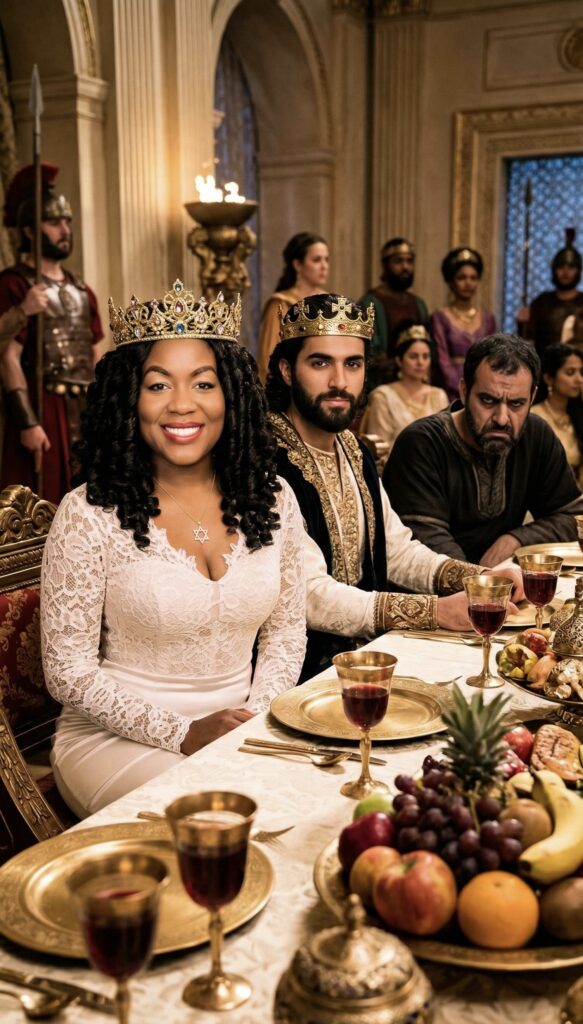
Esther 7:3-4 “Then Esther the queen answered and said, If I have found favour in thy sight, O king, and if it please the king, let my life be given me at my petition, and my people at my request: For we are sold, I and my people, to be destroyed, to be slain, and to perish. But if we had been sold for bondmen and bondwomen, I had held my tongue, although the enemy could not countervail the king’s damage.”
The king understands that the banquets were merely preparing the way for her real request. Esther finally confesses her Jewish nationality, revealing that she and her people are slated for absolute slaughter. She argues on pragmatic, economic, and political grounds that the “enemy” Haman could not countervail the “king’s damage”—meaning Haman’s 10,000 talents of silver could never compensate the king for the catastrophic loss of revenue, labor, and stability that a wholesale massacre of the Jewish population would inflict upon the realm.
A brilliant, intelligent, wise woman knows all her details, just like Queen Esther!
When the stunned king demands to know who authored this plot, Esther points directly at her guest, declaring, “The adversary and enemy is this wicked Haman”. The king, furious at his own complicity, his wounded pride, and Haman’s deception, storms into the palace garden to process the revelation.
Reclining on couches was the customary posture at Persian banquets, and while the king is in the garden, the terrified Haman falls upon the couch where Esther is reclining to beg for his life. When the king re-enters the room, he sees Haman on the queen’s couch and misinterprets his desperate posture as an attempted physical assault.
Esther 7:8-10 “Then the king returned out of the palace garden into the place of the banquet of wine; and Haman was fallen upon the bed whereon Esther was. Then said the king, Will he force the queen also before me in the house? As the word went out of the king’s mouth, they covered Haman’s face. And Harbonah, one of the chamberlains, said before the king, Behold also, the gibbet fifty cubits high, which Haman had made for Mordecai, who had spoken good for the king, standeth in the house of Haman. Then the king said, Hang him thereon. So they hanged Haman on the gibbet that he had prepared for Mordecai. Then was the king’s wrath pacified.”
The king’s accusation of assault seals Haman’s fate. Attendants immediately cover Haman’s face—a Persian custom signifying that a condemned man is unworthy to ever look upon the king’s face again. Harbonah, a eunuch, opportunistically mentions the massive gibbet at Haman’s house. The king orders Haman executed on the very instrument he constructed for Mordecai, demonstrating a profound stroke of poetic and divine justice.
Modern Haman Archetypes Also End Up Hanged On Their Own Gibbets
The archetype of the genocidal vizier found terrifying new expressions in the totalitarian regimes of Europe, but the historical echoes of Purim manifested in astonishing ways.
Adolf Hitler and the “Purimfest 1946” Miracle
Adolf Hitler and the Nazi regime were explicitly understood by Jewish communities as the spiritual descendants of the Agagite. Hitler himself recognized this dynamic and harbored a venomous hatred for the holiday of Purim. He understood that the holiday celebrated the downfall of an antisemitic genocidaire. In 1939, he strictly banned the reading of the Book of Esther and ordered that all synagogues be closed on Purim. Hitler famously stated in 1944 that if Germany lost the war, the Jews would celebrate a “second triumphant Purim Festival”. The Nazis explicitly chose Purim to hang ten Jews in a brutal mockery of the execution of Haman’s ten sons.
Following the defeat of Nazi Germany, the survivors residing in displaced persons camps, organized elaborate Purim festivals in March 1946.
However, the archetypal parallel reached a highly publicized and historically stunning climax at the Nuremberg Trials. Among the high-ranking Nazis sentenced to death by hanging was Julius Streicher, the virulently antisemitic publisher of the propaganda newspaper Der Stürmer. While eleven Nazi leaders were initially sentenced to hang, Hermann Göring committed suicide in his cell just hours before the execution, leaving exactly ten Nazis to be executed on the gibbets—directly and chillingly mirroring the ten sons of Haman hanged in Esther 9:13-14.
In the traditional handwritten Megillah scrolls, three letters in the names of Haman’s ten sons are written significantly smaller than the rest of the text: a tav, a shin, and a zayin. One letter is written larger: a vav. In Hebrew numerology, the large vav represents the number 6 (signifying the sixth millennium of the Hebrew calendar), while the small letters tav (400), shin (300), and zayin (7) total 707. Together, they represent the Hebrew year 5707. The Jewish year 5707 corresponds exactly to late 1946, the precise time the ten Nazi war criminals were hanged at Nuremberg.
The Purim Miracle of Stalin’s Elimination in 1953
On the night of March 1, 1953—a date which coincided exactly with the Jewish holiday of Purim—Stalin suddenly suffered a massive stroke and collapsed in his private quarters. He lay undiscovered and writhing in pain for hours, eventually dying, and a few days later, on March 5. Thousands of Jewish prisoners were freed.
The Reversal of Decrees and the Treatment of the Jews
With Haman dead, the immediate threat to Esther was resolved, but the overarching edict of annihilation against the Jewish people remained active and lethal. According to the unyielding laws of the Medes and Persians, a decree written in the king’s name and sealed with his signet ring could not be altered, repealed, or revoked by anyone—not even the king himself.
In the aftermath of Haman’s execution, the king treats the Jews with unprecedented favor. He gives Haman’s vast estate to Esther and transfers his signet ring to Mordecai, effectively elevating him to the position of Prime Minister. Despite this newfound power, Esther falls at the king’s feet, weeping and pleading for the revocation of Haman’s letters. To bypass the irrevocability of Persian law, the king grants Mordecai, the Benjamite, the authority to write a new, countermanding decree in the king’s name.
Esther 8:11 “The king’s edict granted the Jews in every city the right to assemble and protect themselves; to destroy, kill and annihilate the armed men of any nationality or province who might attack them and their women and children, and to plunder the property of their enemies.”
This second decree did not legally cancel the first; rather, it neutralized its practical effect. It armed the Jews and gave them the royal, legal right to preemptively organize, defend themselves with force, and destroy any armed forces or mobs that sought to attack them on the designated day. Because this new decree carried the full weight of the crown and because Mordecai the Benjamite now held ultimate administrative power over the empire, local Persian governors, lieutenants, and officials actively assisted the Jews out of fear of Mordecai.
When the thirteenth of Adar arrived, the Jews were overwhelmingly victorious over their enemies, though they notably refused to lay their hands on the plunder.
Esther had a subsequent request in Chapter 9 to extend the slaughter for a second day in Susa and to have Haman’s ten dead sons hanged on the gibbets.
God routinely utilizes historical realities to achieve His sovereign promises of preservation, ensuring the survival of the Messianic lineage. We pray that this year, our partnerships, families, and friends will combat antisemitism with intention and stand with the Jewish state of Israel and pray for the peace of Jerusalem always.
If you see, hear, or notice antisemitism of any form, report it to law enforcement and leave it in their hands. Trust our wonderful, competent law enforcement and continue to live a peaceful, joyful life while the laws of the land are set in motion to protect you and others, keeping the peace in our communities as innocent, law-abiding citizens.
Lessons for Daily Life From The Book of Esther
1. Recognizing the Unseen Providence of God: Even in secular environments where the name of God seems entirely absent—such as a pagan government, a hostile workplace, or a culturally assimilated society—His providence is actively orchestrating circumstances to protect His people and fulfill His redemptive purposes. Believers are called to trust in the absolute sovereignty of God, recognizing that serendipitous “coincidences” like a king’s insomnia or a delayed reward are often divine appointments.
2. Embracing the Call: “For Such a Time as This” Mordecai’s challenge to Esther is an enduring, urgent mandate for Christians. God places individuals in specific roles, jobs, and positions of influence not merely for their own comfort, wealth, or safety, but to be utilized as instruments for His Kingdom. When believers face moral crises, systemic injustice, or opportunities to defend the vulnerable, they must ask themselves if God has elevated them to their current status precisely for that moment. Ignoring the call out of self-preservation guarantees spiritual failure.
3. The Necessity of Courage and Holy Risk: Esther’s initial instinct, like many Christians today, was self-preservation through silence. Yet, once convinced of her duty, she accepted the lethal risk of approaching the king, declaring, “If I perish, I perish”. Christians are taught that fidelity to God frequently requires stepping out of comfortable anonymity and risking social, professional, or physical standing. A cowardly silence in the face of evil is a rejection of the divine mission. Esther teaches that true security is found in obedience, regardless of the earthly cost.
4. The Power of Fasting and Dependence on God: Esther’s command to fast for three days demonstrates that spiritual battles require intense spiritual preparation. Before engaging in political or interpersonal confrontation, believers must seek solidarity with the community of faith and humble themselves before God in prayer and fasting, realizing that human strategy, beauty, or rhetorical skill is impotent without divine intervention.
By studying Esther’s intercession, Christians see a reflection of Christ, our ultimate mediator, who risked Himself to approach the throne of judgment and secure a decree of life for those condemned to die. WE BLESS YOU YESHUA!
The Book of Esther is a historical narrative set in the Persian capital of Susa (Shushan) during the reign of King Ahasuerus, who ruled the vast Medo-Persian Empire from 486 to 465 B.C.